Ad Intelligence and Residential Proxies: 7 Ways to Improve Competitor Research in 2026
- Author
- PrimeSpy Research Team
- Published
- Oct 27, 2026

Digital advertising has become increasingly competitive, with brands launching campaigns across multiple platforms, countries, and audience segments. Understanding how competitors advertise is no longer just about identifying their creatives. Marketers also need to examine landing pages, regional differences, campaign messaging, and changes in promotional strategies.
This is where ad intelligence and residential proxies can complement each other.
Ad intelligence platforms help marketers discover advertising patterns and analyze competitor campaigns. Residential proxies, meanwhile, support location-specific website access and automated data collection.
When used together, these technologies can help marketing teams develop a more complete understanding of the competitive landscape.
What Is Ad Intelligence?
Ad intelligence refers to the process of collecting and analyzing publicly available advertising information to understand competitors' marketing activities.
Rather than relying solely on internal campaign performance, businesses can study external signals such as advertising creatives, promotional messaging, landing pages, and campaign trends.
Platforms such as PrimeSpy can be part of this research workflow, helping marketers explore advertising information and identify opportunities for competitive analysis.
However, discovering an advertisement is only one part of the process. Marketers often need to investigate what happens after a user clicks an ad, including the content of the landing page and how that experience varies across markets.
Why Residential Proxies Matter for Advertising Research
A residential proxy routes an internet connection through an IP address associated with a residential internet service provider.
Unlike a conventional server IP address, a residential IP can help researchers access websites from different geographic locations and examine the content available to users in those markets.
For international advertising research, this can be particularly useful.
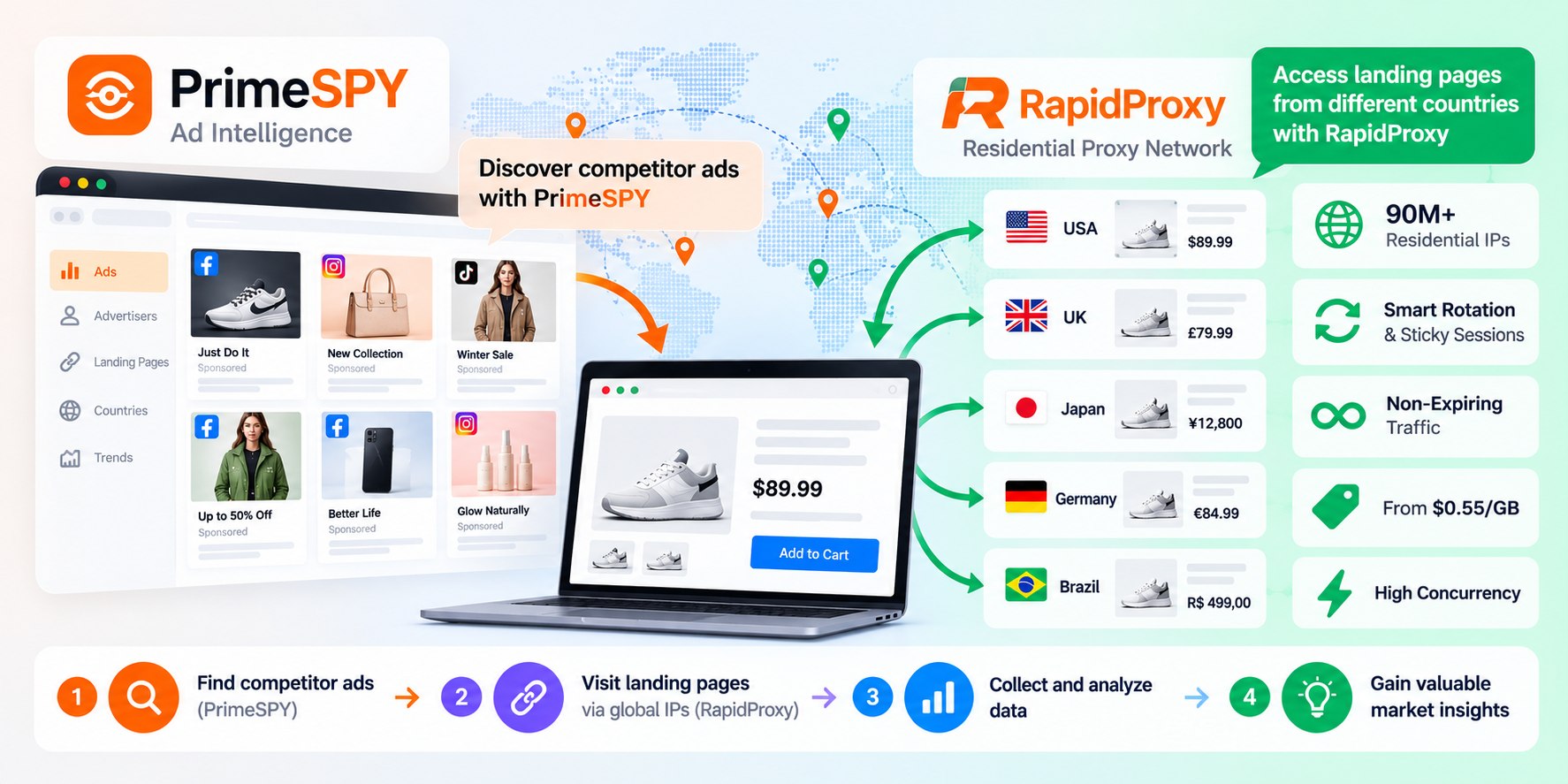
For example, a marketing team based in the United States may want to investigate a competitor's promotional campaigns in Germany, Japan, and Brazil.
The competitor may display different product prices, landing pages, languages, or promotional offers depending on the visitor's location.
Residential proxies provide a way to test these regional experiences without requiring researchers to be physically present in each country.
However, IP location is only one factor influencing website content. Cookies, browser language, account status, and other signals may also affect what a visitor sees.
7 Ways Ad Intelligence and Residential Proxies Improve Competitor Research
1. Analyze Competitor Landing Pages Across Countries
A competitor may use the same advertisement in several countries while directing visitors to different landing pages.
These regional pages may feature different prices, currencies, shipping policies, or product recommendations.
By combining ad intelligence research with geographically targeted website access, marketers can compare the customer experience across markets.
For example, a team investigating a competitor's European campaigns could examine whether visitors in France and Germany receive the same promotional offers.
This helps identify localization strategies that might otherwise remain unnoticed.
2. Monitor Changes in Promotional Messaging
Advertising campaigns evolve continuously.
Brands frequently test new headlines, discounts, calls to action, and product positioning to improve performance.
Ad intelligence tools help marketers discover campaign messaging, while automated website monitoring can help identify changes to associated landing pages.
Residential proxies can support geographically distributed monitoring when the website serves different content based on visitor location.
This allows marketing teams to compare how promotional messaging changes over time and across markets.
3. Research Competitor Pricing Strategies
Pricing is one of the most important competitive signals in ecommerce and subscription-based businesses.
However, the price displayed on a website may vary depending on the visitor's country, currency, or regional promotion.
A structured research workflow can collect publicly accessible product prices from selected markets and compare them with the offers promoted in advertising campaigns.
For example, a company might discover that a competitor advertises a global discount but applies different final prices in individual countries.
These findings can inform pricing analysis, although researchers should account for taxes, exchange rates, and shipping costs before drawing conclusions.
4. Compare Advertising and Landing Page Consistency
An effective advertisement should align with the landing page that users see after clicking.
If an ad promotes a particular product or discount but the landing page shows something different, users may experience confusion.
Marketing teams can review publicly available advertisements and inspect their associated landing pages to identify inconsistencies.
Useful comparison fields include:
| Advertising Element | Landing Page Element |
|---|---|
| Promotional headline | Main page headline |
| Advertised discount | Displayed promotional price |
| Product description | Product details |
| Call to action | Conversion button |
| Target country | Language and currency |
This process helps researchers understand how competitors structure their customer journeys.
5. Track Regional Campaign Localization
Successful international advertising often requires more than translating the same message into multiple languages.
Brands may adjust imagery, product positioning, seasonal promotions, and calls to action to match local preferences.
For example, a retailer may emphasize fast delivery in one country while highlighting affordability in another.
Ad intelligence can reveal differences in campaign creatives, while residential proxies can help researchers examine the associated regional website experiences.
Together, these observations provide useful insights into how competitors approach international markets.
6. Automate Public Website Monitoring
Manual competitor research becomes difficult when teams need to examine dozens of competitors across multiple markets.
Automation can help collect selected information at regular intervals.
A typical workflow might involve:
- Identifying competitor advertisements and associated landing pages.
- Creating a list of publicly accessible URLs for monitoring.
- Selecting relevant geographic locations.
- Collecting page titles, prices, promotional text, and other relevant fields.
- Comparing results with previous observations.
- Generating reports when meaningful changes occur.
Residential proxy services such as RapidProxy can support the network-access component of these workflows by providing rotating and sticky residential IP sessions.
Rotating sessions can distribute independent collection requests across different IP addresses, while sticky sessions can maintain a consistent IP when a workflow requires continuity.
Automation should respect applicable laws, website terms, privacy requirements, and reasonable request limits.
7. Improve Competitive Research With Historical Data
Individual advertising observations provide only a snapshot of a competitor's strategy.
Historical comparisons are often more valuable.
For example, tracking promotional messages over several months can reveal recurring discount periods, seasonal campaigns, and changes in product positioning.
When marketers combine advertising observations with historical landing-page data, they can identify patterns that may support future campaign planning.
The goal is not simply to collect more information, but to turn relevant observations into actionable business insights.
How to Build a Practical Ad Intelligence Workflow
A useful research workflow should begin with a clear business question.
For example:
How does a competitor promote the same product across different countries?
Once the objective is defined, marketers can select appropriate tools and establish a repeatable process.
| Workflow Stage | Purpose | Technology |
|---|---|---|
| Advertising discovery | Identify relevant campaigns and creatives | Ad intelligence platform |
| Landing page research | Examine associated website experiences | Browser or web crawler |
| Geographic comparison | Access region-specific public content | Residential proxies |
| Data extraction | Collect selected page information | Scraping or parsing tools |
| Reporting | Identify trends and changes | Analytics and reporting tools |
A platform such as PrimeSpy can contribute to the advertising discovery stage, while RapidProxy can provide residential proxy infrastructure for geographically distributed website research.
The two technologies serve different purposes but can complement each other within a broader competitive intelligence workflow.
Best Practices for Reliable Advertising Research
Maintain Consistent Research Conditions
When comparing websites across countries, researchers should document the IP location, browser language, device type, and session settings.
Otherwise, differences caused by browser configuration may be mistaken for genuine regional marketing changes.
Validate Collected Information
Automated extraction is not always accurate.
Websites frequently change their structure, and dynamically rendered pages may require additional processing.
Important findings should be validated before they influence pricing or advertising decisions.
Focus on Relevant Metrics
Collecting large amounts of data does not automatically improve competitive intelligence.
Marketing teams should prioritize information directly connected to their objectives, such as promotional offers, landing-page changes, regional positioning, and campaign consistency.
Respect Privacy and Website Policies
Research should focus on lawfully accessible information and comply with applicable privacy rules, website terms, and data collection restrictions.
Residential proxies should not be treated as a substitute for authorization or compliance.
Conclusion
Ad intelligence and residential proxies address two different but complementary challenges in modern competitive research.
Ad intelligence helps marketers understand how competitors promote their products, while residential proxies support geographic website analysis and automated collection of publicly available information.
By combining advertising insights with structured landing-page research, businesses can gain a more complete understanding of competitor positioning, promotional strategies, and regional market differences.
Tools such as PrimeSpy and RapidProxy can contribute to different stages of this process, helping marketing teams build more systematic and informed competitive research workflows.